

Thinking about buying or already living in a mobile home in California, but unsure what kind of taxes you’ll be hit with? You’re not alone. Many mobile homeowners are surprised to learn that their tax obligations aren’t as straightforward as traditional real estate.
Between DMV fees, property taxes, and complicated classifications, it’s easy to get lost in the fine print. And if you’re planning to sell, inherit, or move your mobile home, not knowing the right tax structure could cost you time and money.
So, do you pay property taxes on mobile homes in California? The answer isn’t a simple yes or no, and it depends on several key factors.
In this blog, we’ll break down how mobile home taxes work in California, what determines your tax status, and what you need to do to stay compliant and avoid penalties. Let’s clear up the confusion and help you plan with confidence.
Do I Pay Property Taxes on Mobile Homes in California?
Yes, but it’s not always as straightforward as it seems. Many mobile homeowners are surprised to learn that their tax responsibilities can vary depending on how their home is classified and handled by the state.
Whether you’re planning to buy, sell, or simply understand your current obligations, it’s important to know where your mobile home stands in the eyes of California law.
Curious how it all works? Read on to learn what really determines if and how you pay property taxes on your mobile home in California.
How are Mobile Homes Taxed in California?

In California, mobile homes are subject to one of two primary taxation systems: Local Property Tax or In-Lieu License Fees (commonly referred to as the Vehicle License Fee or VLF). The applicable system depends on when the home was purchased, whether it’s on a permanent foundation, and how it’s titled. Here’s a breakdown of both types:
1. Local Property Tax
Local property tax refers to the county-assessed tax applied to mobile homes that are classified as real property in California. This typically applies to manufactured homes that are permanently affixed to land, especially those built on or after July 1, 1980, or voluntarily converted from vehicle registration.
Here’s how it works:
- The home is placed on the local tax roll by the county assessor.
- It receives its own separate base year value, which can increase annually based on the California Consumer Price Index.
- You’ll receive a supplemental tax bill installment upon purchase or change in ownership, followed by a first installment of your annual tax bill.
- The amount owed includes the general property tax rate plus direct assessments for local services (like schools or fire districts).
Additionally, if the home is your principal place of residence, you may qualify for exemptions that reduce your tax burden.
2. In-Lieu License Fees (Vehicle License Fee System)
In California, in-lieu license fees refer to the annual fees paid instead of local property taxes for certain mobile homes. This system applies primarily to mobile homes manufactured before July 1, 1980, that are still registered as personal property with the California Department of Housing and Community Development (HCD).
Here’s how the Vehicle License Fee (VLF) system works:
- These homes are not placed on the local tax roll.
- Instead of paying county-assessed property taxes, owners pay an annual vehicle license fee directly to the HCD.
- The fee is based on the value and age of the mobile home and typically decreases over time.
Since these homes are not treated as real property, they do not receive a base year value, and property tax exemptions do not apply.
When is a Mobile Home Subject to Property Tax?
A mobile home becomes subject to local property taxation in California when it meets specific criteria set under state and county regulations. Generally, this applies when the home is treated as real property rather than personal property.
Your mobile home may be subject to property tax if:
- It was built on or after July 1, 1980.
- It is installed on a permanent foundation.
- The title is recorded with the county recorder’s office instead of the HCD.
- It is placed on privately owned land.
- It has been voluntarily converted from the VLF system to a local property tax.
- It is sold or transferred, triggering a new base year value and a possible supplemental tax bill installment.
- It is used as your principal place of residence and qualifies for property tax exemptions.
When these conditions are met, the home is placed on the local tax roll and assessed annually, subject to direct assessments and the general property tax rate.
When is a Mobile Home Subject to VLF Instead?
A mobile home is taxed under the Vehicle License Fee (VLF) system, instead of local property tax, when it’s classified as personal property and registered with the California Department of Housing and Community Development (HCD).
Your mobile home is likely subject to VLF if:
- It was built before July 1, 1980, and has not been converted to local property taxation.
- It is not installed on a permanent foundation.
- Title and registration are held with the HCD, not the county.
- It is located in a mobile home park or on rented land.
- It has not been transferred or sold in a way that triggers reassessment under property tax law.
- It remains in the original vehicle classification system and hasn’t been voluntarily changed.
Under this system, owners pay an annual license fee, typically lower than local property taxes. However, these homes generally do not qualify for property tax exemptions tied to a principal place of residence.
Can You Switch from VLF to Property Taxes (or Vice Versa)?
Yes, you can, but only in one direction.
In California, mobile homeowners can voluntarily convert from the Vehicle License Fee (VLF) system to the local property tax system, but they cannot switch back once the change is made. This process is known as conversion to local property taxation, and it involves filing a Form 433A with your county when your mobile home is placed on a permanent foundation.
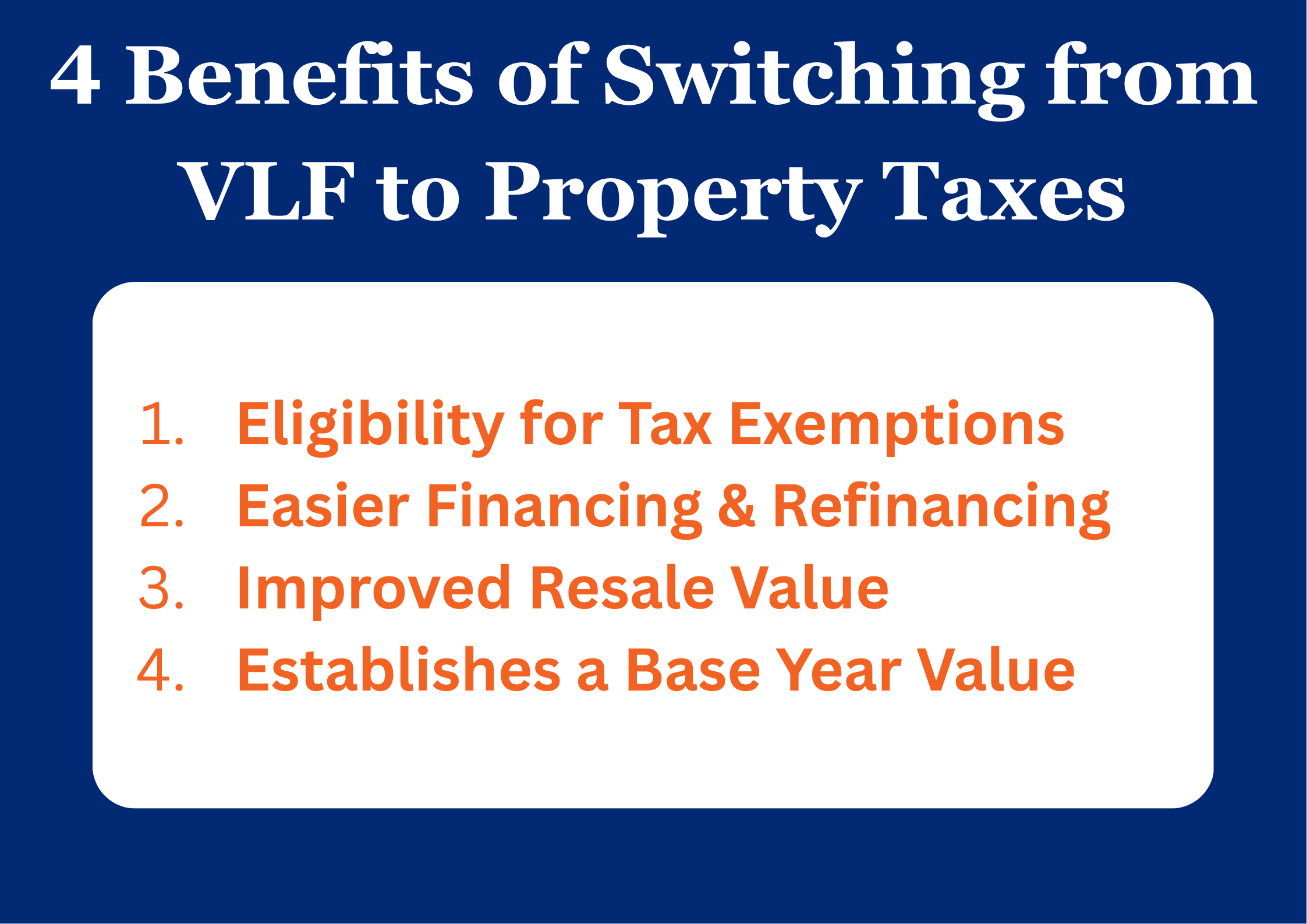
If you’re considering making the switch, here are a few possible advantages that may work in your favor:
- Eligibility for Tax Exemptions: If the home is your principal place of residence, you may qualify for the Homeowners’ Exemption, lowering your tax bill.
- Easier Financing & Refinancing: Homes classified as real property often have better financing options, including lower interest mortgage loans.
- Improved Resale Value: Buyers may prefer homes already on the tax roll, as they’re treated more like traditional real estate.
- Establishes a Base Year Value: Your home will get its own separate base year value, which limits how much property taxes can increase annually (per Proposition 13).
How to Calculate Property Taxes for Mobile Homes?

If your mobile home in California is classified as real property, it’s subject to local property taxes, just like a traditional house. Understanding how these taxes are calculated helps you budget accurately and avoid surprises.
Step 1: Know Your Home’s Assessed Value
The county assessor determines the assessed value of your mobile home based on its current fair market value, specifically the base year value of a manufactured home. This value is typically set at the time of purchase or when the house is converted to real property (e.g., placed on a permanent foundation).
After that, a different valuation rule applies for annual increases in assessed value, which are generally capped at 2% per year under Proposition 13, unless there’s a new sale or significant improvement.
Step 2: Understand the Base Tax Rate
The base property tax rate in California is 1% of the assessed value. However, counties may apply additional voter-approved assessments for purposes such as schools, fire protection, or local services.
Example:
If your mobile home is assessed at $150,000:
- Base tax = 1% of $150,000 = $1,500
- Add local assessments (varies by location, usually 0.1%–0.5%)
- Total property tax might range from $1,500 to $2,250 annually
Step 3: Look for Exemptions
You may qualify for a homeowner’s exemption, which reduces your taxable value by $7,000 from the full value of a manufactured home. This homeowner’s exemption can save you about $70 per year in taxes.
Before you assume you’re paying the full amount, take a moment to see if you fall into any of the exemption categories mentioned below.
Who May Be Exempt from Mobile Home Property Taxes?
You could qualify for a partial or full exemption if you meet any of the following:
- Seniors (Age 62 and above) with limited income.
- Disabled individuals receiving SSI or SSDI benefits.
- Veterans with service-connected disabilities.
- Low-income homeowners under the Property Tax Postponement Program.
- Principal residence owners who meet standard exemption criteria.
For additional information, consult your county assessor’s office or visit the California State Controller’s website to apply.
Late on Mobile Home Property Taxes? Here’s What to Expect
Missing your mobile home property tax deadline in California can lead to serious consequences:
- Penalties & Interest: Late payments typically incur penalties plus monthly interest charges.
- Delinquent Status: Unpaid taxes can result in your home being labeled as tax-defaulted.
- Tax Sale Risk: Continued non-payment may lead to the home being sold at a public auction by the county.
- No Tax Clearance: You won’t be able to sell or transfer the home without a tax clearance certificate.
To avoid these issues, pay your first installment of your annual tax bill on time and contact your county tax collector for help if you fall behind.
We Make Selling Your Mobile Home Simple and Stress-Free
At California Mobile Home Buyer, we specialise in helping mobile homeowners sell quickly, easily, and without the usual headaches. Whether your home needs repairs, is in a park, or you’re facing a tight timeline, we’re here to help.
We buy mobile homes directly, so you don’t have to deal with agents, listings, or lengthy wait times. Our process is fast, transparent, and tailored to your specific needs. You’ll get a fair cash offer, and we’ll handle everything from paperwork to closing.
Here’s what we offer:
- Fast, no-obligation cash offers
- No commissions, fees, or hidden costs
- We buy homes in any condition
- A hassle-free experience backed by years of expertise
If you’re ready to sell your mobile home without the stress, we’re prepared to make it happen. Contact us and sell your mobile home now.
Conclusion
It is essential to understand property taxes for mobile homes in California, including the payment of vehicle fees. This helps owners comply with tax regulations. There is a difference between local property taxes and vehicle license fees. This difference can affect the amount you need to pay, depending on the location of your home and its year of construction. If you learn about possible tax breaks and special rules, you can better manage your tax costs. Taking these steps does not just help you follow the tax laws. They also allow you to maximise the value of your mobile home investment.
Frequently Asked Questions
Are property taxes the same for all mobile homes in California?
No, property tax in California is not the same for every place or home. It changes based on what kind you have. Homes with permanent foundations are required to pay local property tax. Other homes are counted as personal property. These homes have to pay license fees each year instead of a tax. The taxation code explains when and how these rules apply.
What happens if I don’t pay my mobile home property taxes on time?
If you pay late, miss the first instalment of your annual tax bill, you may have extra charges, liens, or even have your property at risk. Unpaid taxes after the applicable delinquency date can cause the tax collector to take steps against you. Always review your tax bill and be aware of your deadlines.
How much are property taxes on mobile homes in California?
Mobile home property taxes are generally around 1% of the assessed value, plus direct assessments. The assessed value may increase annually based on the California Consumer Price Index, capped by Proposition 13.
Is mobile home space rent tax deductible in California?
No, mobile home space rent is not tax-deductible on your California state income taxes. However, you may qualify for a renter’s tax credit if you meet income and residency requirements.
Is there sales tax on mobile homes in California?
Yes, sales tax applies to new mobile homes purchased from dealers. Used mobile homes are typically exempt if sold privately, but may still trigger use tax in certain transactions.